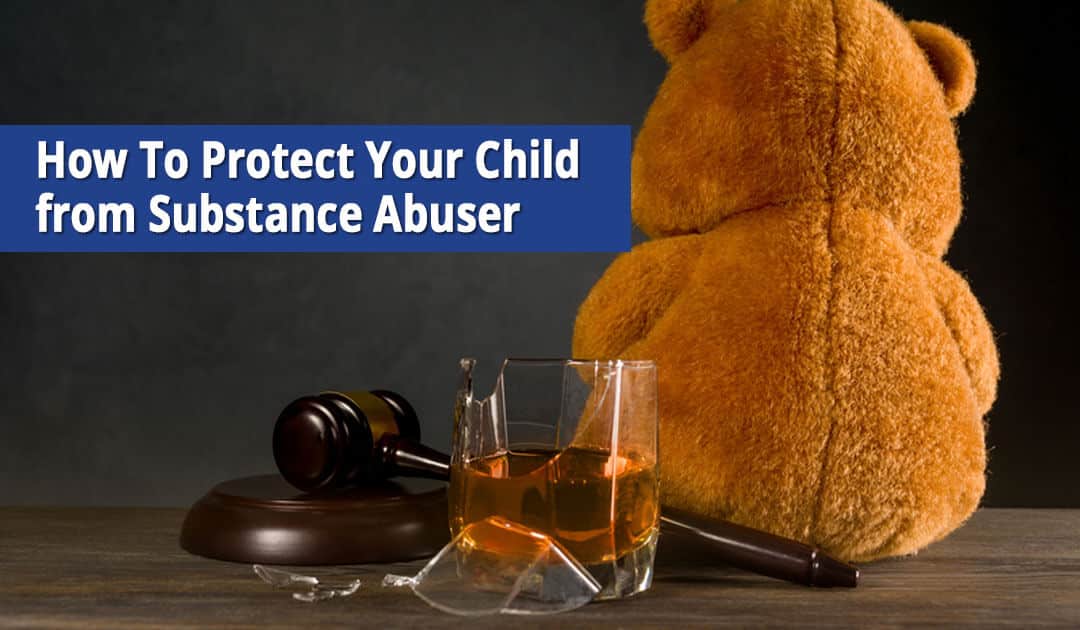
Child custody matters in divorce are often wrought with emotion and are often simultaneously frustrating and heartbreaking. This is especially true when one parent struggles with addiction. When you need to protect your child or children from your ex, it can be very difficult to manage your emotions while trying to prove to the court why your ex should not have child custody or unsupervised visitation with your children.
Here’s what you should know about handling a child custody case involving substance abuse and how you can get legal assistance when you need it most.
If you’re alleging that your ex has a substance abuse problem and should not be awarded custody or visitation with your children, you have the burden of proof. This means you must bring evidence to the table that supports your claims and shows compelling reasons why a court or judge should rule in your favor.
A court is unlikely to side with you without at least one or two strong pieces of evidence that indicate your ex is struggling with an addiction problem. In fact, the more evidence you have to prove your case, the better your chances of success will be. Some types of evidence you may be able to bring to court to back up your claims include but are not limited to:
In many cases, parents with an addiction issue can go through a rehabilitation program and if successful, earn back custody and/or visitation with their children. Long Island family courts recognize the need for children to have a meaningful relationship with both parents whenever possible, and mandatory rehabilitation is sometimes ordered in child custody cases to help give the addicted parent the best chance possible to reconnect with their children.
However, this may not be automatic. It may be necessary for you to bring up the possibility of mandatory rehabilitation or request that the judge overseeing your family law case consider it. You may also want to provide clear reasoning as to why you believe mandatory rehabilitation in order to obtain custody and/or visitation is warranted. You should also include compelling evidence as to why voluntary rehabilitation is unlikely to be successful.
Most often, parents who have substance abuse issues are allowed to have some degree of supervised visitation. This means that the children are allowed to meet with their other parent on a specific schedule at a neutral place with an unrelated third party present.
If you are uncomfortable with the idea of your ex freely having visitation with your children, you can ask the court to consider supervised visitation. You’ll need to again show convincing evidence as to why you believe this to be necessary.
At Hornberger Verbitsky, P.C., we’ve represented many parents who need to take swift action to protect their children from another parent who has a substance abuse problem. We can help guide your family through the difficult next steps and provide you with the resources and legal advocacy you need to navigate such a difficult situation.
Call our office today for a free initial consultation at 631-923-1910 or fill in the short form on this page. Our seasoned Long Island family lawyers are available now to assist you.
Schedule your complimentary consultation and case evaluation with our experienced attorneys today. When you call, you’ll speak to our friendly Client Services Director, who will be able to answer your general questions and set up your appointment with an attorney who specializes in your unique case.
At your meeting, your attorney will describe the many options available and determine together which is the right solution for you. By the end of this meeting we’ll all understand how we can best help you to move forward.
There is no cost or obligation for this initial consultation. It is simply an opportunity for us to get to know each other, answer your questions and learn if Hornberger Verbitsky, P.C. is right the right law firm for you. Give us a call at 631-923-1910 or fill in the short form below to schedule your free consultation and case evaluation.
All Fields Are Required


