
Home »
Equitable Distribution Examples & FAQs for Nassau and Suffolk County Divorce Cases
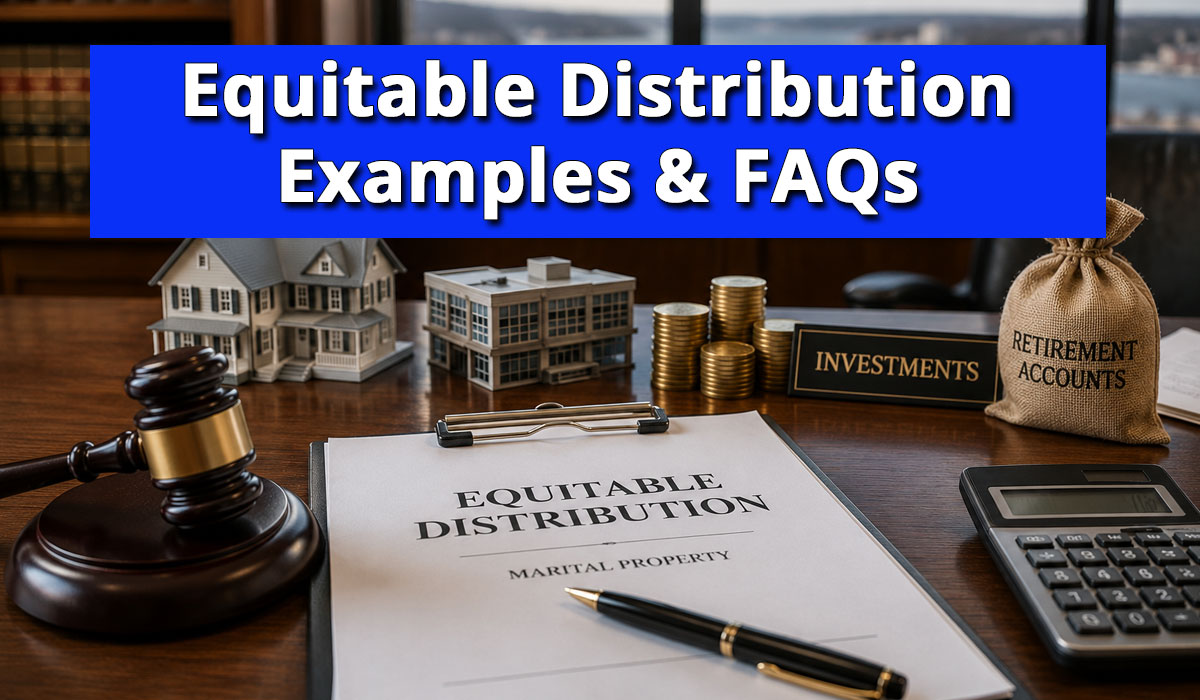
Quick Answer: What Does Equitable Distribution Look Like in Real Long Island Divorce Cases?
Every equitable distribution case is unique. While New York law requires marital property to be divided fairly rather than automatically divided equally, the specific outcome depends on the assets involved, the length of the marriage, each spouse’s financial circumstances, and numerous other factors.
The examples below illustrate how equitable distribution principles are commonly applied in Nassau County and Suffolk County divorce cases involving family homes, business interests, executive compensation, inheritances, and high-net-worth assets.
For a detailed explanation of how New York equitable distribution laws work, including the distinction between marital and separate property, visit our comprehensive guide to Equitable Distribution in Nassau and Suffolk County Divorce Cases.
Why Long Island Equitable Distribution Cases Often Require Specialized Financial Analysis
While every divorce involves property division, in high net worth divorces equitable distribution disputes in Nassau County and Suffolk County frequently involve assets that require specialized valuation and financial analysis.
Examples include:
- Closely held businesses
- Professional practices
- Executive compensation packages
- Stock options and RSUs
- Retirement accounts and pensions
- Trusts and inherited wealth
- Investment portfolios
- Cryptocurrency holdings
- Commercial real estate
As asset complexity increases, courts and attorneys often rely on forensic accountants, business valuation experts, real estate appraisers, executive compensation specialists, and tax professionals to help accurately identify, value, and distribute marital assets. For these types of cases, it is in your best interest to retain a lawyer experienced in high net worth divorce as they will have the experience and contacts to specialized experts to protect your best interests.
The examples below demonstrate how these issues frequently arise in Long Island divorce cases.
Real-World Examples of Equitable Distribution in Long Island Divorce Cases
Because equitable distribution is highly fact-specific, no two divorces are exactly alike. The following examples illustrate how New York courts may approach common property division issues affecting Long Island families.
Example 1: Dividing a Long Island Family Home
A couple owns a marital residence in Smithtown valued at $1.4 million with a remaining mortgage balance of $350,000.
The home contains approximately $1.05 million in equity.
Potential outcomes could include:
• Selling the property and dividing the proceeds.
• One spouse buying out the other’s share.
• Delaying the sale until minor children reach adulthood.
• Offsetting the home’s value against other marital assets.
The most appropriate solution often depends on cash flow, housing needs, and overall asset distribution.
Example 2: Business Ownership in a Nassau County Divorce
A physician owns a medical practice in Garden City that was established during the marriage.
Although the practice is operated solely by the physician spouse, the business may still be considered marital property because it was developed during the marriage.
The court may consider:
• Business value
• Goodwill
• Accounts receivable
• Future earning potential
• Ownership restrictions
Rather than dividing ownership directly, courts frequently award the business to the operating spouse and offset its value through other marital assets.
Example 3: Executive Compensation in a Suffolk County Divorce
An executive working in Manhattan receives:
• RSUs
• Stock options
• Annual bonuses
• Deferred compensation
Although some compensation may not vest until after divorce, portions earned during the marriage may still be subject to equitable distribution.
These cases often require:
• Vesting schedule analysis
• Tax planning
• Executive compensation valuation
• Financial expert testimony
Example 4: Inherited Wealth and Separate Property
A spouse inherits $2 million from a parent and keeps the funds in a separate brokerage account.
Because the inheritance remained segregated and properly documented, it may remain separate property.
However, if the inherited funds were deposited into joint accounts or used to purchase marital assets, part of the inheritance could potentially become marital property.
Why Equitable Distribution Becomes More Complex in High-Net-Worth Divorce
High-net-worth divorces on Long Island frequently involve assets that require specialized valuation and analysis.
Common examples include:
1. Closely Held Businesses. Businesses often require professional valuation experts to determine fair market value.
2. Professional Practices. Physicians, attorneys, dentists, accountants, and consultants frequently face disputes involving goodwill and future earnings.
3. Commercial Real Estate. Investment and commercial properties often involve complex financing arrangements and valuation issues.
4. Trusts and Family Wealth. Multi-generational wealth transfers frequently require tracing and trust analysis.
5. Executive Compensation. RSUs, stock options, carried interest, and deferred compensation plans often represent substantial marital assets.
6. Investment Portfolios. Complex portfolios may include:
• Stocks
• Bonds
• Private equity
• Venture capital interests
• Cryptocurrency
• International investments
As asset complexity increases, so does the importance of accurate valuation and financial analysis.
The Role of Financial Experts in Equitable Distribution Cases
Many high-asset divorces require a team of professionals beyond the attorneys involved.
These experts may include:
1. Forensic Accountants
• Forensic accountants help identify:
• Hidden assets
• Income manipulation
• Asset tracing
• Business cash flow
2. Business Valuation Experts
These professionals determine the value of:
• Family businesses
• Professional practices
• Partnership interests
• Closely held corporations
3. Real Estate Appraisers
Appraisers provide opinions regarding:
• Residential property values
• Commercial property values
• Investment property valuations
4. Tax Professionals
Tax advisors help evaluate:
• Capital gains exposure
• Retirement account taxation
• Business sale implications
• Settlement structures
The larger the marital estate, the more important these experts often become.
Key Takeaways About Equitable Distribution in Long Island High Net Worth Divorce Cases
• New York is an equitable distribution state, not a community property state.
• Fair does not necessarily mean equal.
• Courts divide marital property based on numerous statutory factors.
• Nassau County and Suffolk County courts regularly handle complex high-net-worth divorce cases.
• Businesses, executive compensation, retirement accounts, trusts, inheritances, and investment portfolios often require specialized valuation.
• Separate property can become marital property through commingling or active appreciation.
• Hidden assets and incomplete financial disclosure can significantly impact property division.
• Tax consequences should always be considered when negotiating settlements.
• Mediation may work in some cases, while litigation may be necessary in others.
• Experienced legal and financial guidance can help protect your long-term financial interests.
Final Thoughts About Equitable Distribution Examples in Nassau and Suffolk County Divorce Cases
For many Long Island families, equitable distribution is the single most important financial issue in a divorce. The outcome may determine where you live, your retirement security, your ownership interests in a business, and your overall financial future.
Whether your case involves a marital residence in Nassau County, a business in Suffolk County, executive compensation from a New York City employer, inherited wealth, or a multi-million-dollar investment portfolio, understanding how New York equitable distribution laws apply to your circumstances is essential.
A well-planned property division strategy can help preserve wealth, minimize unnecessary taxes, and provide greater financial stability long after the divorce is finalized.
Protecting Your Financial Future During Equitable Distribution
Equitable distribution is often the most financially significant aspect of a divorce. Whether your marital estate includes a family home, retirement accounts, investment portfolios, business interests, executive compensation, inherited assets, or trusts, the way property is classified, valued, and divided can have long-lasting consequences for your financial future.
Because New York follows equitable distribution rather than a strict 50/50 division system, the outcome of a property division dispute depends on the specific facts of each case. Courts in Nassau County and Suffolk County regularly address complex issues involving separate property claims, business valuation, professional practices, executive compensation, tax consequences, hidden assets, and high-net-worth estates.
Understanding your rights, and the potential risks associated with property division, is essential before agreeing to any settlement. A well-structured equitable distribution strategy can help preserve wealth, minimize unnecessary taxes, protect important assets, and provide greater financial security after divorce.
If your divorce involves substantial assets, business ownership interests, executive compensation, trusts, inheritances, real estate holdings, or complex financial issues, experienced legal guidance can make a significant difference in the outcome of your case.
The experienced Long Island divorce attorneys at The Long Island Divorce & Family Law Group, Hornberger Verbitsky, P.C. represent clients throughout Nassau County and Suffolk County in divorce matters involving equitable distribution, complex asset division, high-net-worth estates, business valuation disputes, executive compensation, and sophisticated financial issues.
Contact our office today at 631-923-1910 or fill in the short form below to schedule your free confidential consultation and case evaluation
FAQs about Equitable Distribution in Divorce on Long Island, NY
What is equitable distribution in a New York divorce?
Equitable distribution is the process New York courts use to divide marital property during divorce. Rather than automatically dividing assets equally, courts seek a distribution that is fair based on the unique circumstances of the marriage and the parties involved.
Is New York a 50/50 divorce state?
No. New York is not a community property state. Courts in Nassau County and Suffolk County divide marital assets according to equitable distribution principles, which focus on fairness rather than an automatic 50/50 split.
What property is considered marital property in a Long Island divorce?
Marital property generally includes assets acquired by either spouse during the marriage, including homes, retirement accounts, businesses, investment accounts, executive compensation, vehicles, and other property accumulated while married.
What property is considered separate property in New York?
Separate property typically includes assets owned before marriage, inheritances, gifts received from third parties, certain trust interests, personal injury awards, and assets protected through prenuptial or postnuptial agreements.
How do Nassau County and Suffolk County courts divide property during divorce?
Judges in Nassau County Supreme Court and Suffolk County Supreme Court evaluate factors such as the length of the marriage, each spouse’s income, future earning capacity, financial contributions, non-financial contributions, tax consequences, and the nature of the assets when determining an equitable distribution.
Is the family home always divided equally in a divorce?
Not necessarily. Courts may order the home sold, award the home to one spouse, or structure a buyout depending on factors such as children, finances, mortgage obligations, and the overall property division plan.
Can one spouse keep the marital home after divorce?
Yes. In many Long Island divorce cases, one spouse buys out the other spouse’s interest in the property and refinances the mortgage. The feasibility of this option depends on income, financing, and available assets.
How are retirement accounts divided in a Nassau or Suffolk County divorce?
The portion of retirement accounts accumulated during the marriage is generally considered marital property. Division often requires a Qualified Domestic Relations Order (QDRO) to avoid unnecessary taxes and penalties.
Can pensions be divided in a New York divorce?
Yes. Pensions earned during the marriage are often subject to equitable distribution and may be divided between spouses based on the portion accumulated during the marriage.
How is a business divided in a Long Island divorce?
Business interests may be valued by a business valuation expert and divided through buyouts, asset offsets, structured settlements, or other arrangements. The business itself is not always physically divided between spouses.
What happens to a professional practice during divorce?
Medical practices, law firms, dental practices, accounting firms, and other professional businesses may be subject to valuation and equitable distribution analysis. Courts often consider goodwill, income, and future earning potential.
Are stock options and RSUs marital property?
They can be. Restricted Stock Units (RSUs), stock options, deferred compensation, and executive bonuses earned during the marriage may be subject to equitable distribution, depending on vesting schedules and the purpose of the compensation.
How are executive compensation packages divided during divorce?
Courts often evaluate grant dates, vesting schedules, employment agreements, and whether the compensation was awarded for past services performed during the marriage or future services after separation.
Are inheritances divided in a New York divorce?
Generally, inheritances are considered separate property. However, inherited assets may become marital property if they are commingled with marital funds or actively enhanced through marital efforts.
What happens if inherited money is deposited into a joint account?
Depositing inherited funds into a joint account may create a commingling issue. Depending on the circumstances, all or part of the inheritance could become marital property.
Can trust assets be divided during divorce?
It depends on the type of trust, the beneficiary’s rights, trust distributions, and the level of control over the trust assets. Some trusts remain protected while others may become relevant to equitable distribution or support calculations.
What is asset tracing in divorce?
Tracing is the process of proving the source and ownership history of assets. It is commonly used in high-net-worth divorces involving inheritances, trusts, business interests, and separate property claims.
What is active appreciation?
Active appreciation occurs when an asset increases in value because of the efforts of one or both spouses during the marriage. This appreciation may become marital property even if the original asset was separate property.
What is passive appreciation?
Passive appreciation occurs when an asset increases in value due to market forces, inflation, or economic conditions rather than marital effort. Passive appreciation often remains separate property.
Can cryptocurrency be divided during divorce?
Yes. Cryptocurrency such as Bitcoin, Ethereum, and other digital assets are generally treated as property and may be subject to equitable distribution if acquired during the marriage.
How do courts determine the value of cryptocurrency?
Courts may rely on account records, blockchain analysis, exchange statements, and expert testimony to determine ownership and value.
What happens if a spouse hides assets during divorce?
If a spouse conceals assets, the court may impose sanctions, reopen settlements, award a greater share of property to the innocent spouse, or impose other penalties.
How are hidden assets discovered?
Hidden assets are often uncovered through financial discovery, subpoenas, forensic accounting investigations, business record reviews, tax return analysis, and expert testimony.
Do tax consequences matter in equitable distribution?
Yes. Taxes can significantly affect the actual value of assets. Courts and attorneys often consider capital gains taxes, retirement account taxation, deferred compensation taxes, and other financial consequences when negotiating settlements.
Is mediation better than litigation for property division?
Mediation can reduce costs, preserve privacy, and provide more flexibility. Litigation may be necessary when there are hidden assets, business valuation disputes, executive compensation issues, trust disputes, or high-conflict circumstances.
How long does equitable distribution take in a Long Island divorce?
The timeline varies depending on the complexity of the assets, the level of cooperation between spouses, the need for expert valuations, and whether the case settles or proceeds to trial.
What types of experts are commonly used in high-net-worth divorce cases?
Experts frequently include forensic accountants, business valuation professionals, real estate appraisers, pension evaluators, executive compensation specialists, and tax advisors.
Do I need a lawyer for a high-net-worth divorce in Nassau or Suffolk County?
High-net-worth divorces involving businesses, executive compensation, trusts, inheritances, real estate, and substantial investment assets often require experienced legal counsel and financial experts to protect your interests and ensure accurate valuation and distribution of assets.
REQUEST YOUR COMPLIMENTARY MATTER REVIEW TODAY
Call 631-923-1910 or fill in the form below

The Long Island Divorce & Family Law Group, Hornberger Verbitsky, P.C. partners Robert E. Hornberger, Esq. and Christine M. Verbitsky, Esq.
At your matter review meeting, we will:
- Conduct a Comprehensive Review of your particular situation
- Provide a Full Explanation of the Legal Issues involved in your matter
- Discuss your Goals and Objectives
- Develop a Strategic Plan to Achieve your Goals
- Answer All of Your Questions & Concerns
- Provide Advice on collecting Key Documentation and Evidence to gather to achieve your desired outcome
We will describe the many options available to determine together the right solution for you. By the end of this conversation, we’ll all understand how we can best help you to move forward.
Complimentary & Confidential
There is no cost or obligation for this initial matter review. It is simply an opportunity for us to get to know each other, answer your questions and learn if The Long Island Divorce & Family Law Group, Hornberger Verbitsky, P.C. is right the right law firm for you. Give us a call at 631-923-1910 or fill in the short form below for your free matter review.
What to Expect When Hiring a Divorce Lawyer
✅Conduct a Comprehensive Review of your unique situation
✅Provide a Full Explanation of the Legal Issues involved in your matter
✅Discuss your Goals and Objectives
✅Develop a Strategic Plan to Achieve your Goals
✅Answer All of your Questions & Concerns
✅Provide Advice on collecting Key Documentation and Evidence to gather to achieve your desired outcome












At your consultation, we will:
- Conduct a Comprehensive Review of your particular situation
- Provide a Full Explanation of the Legal Issues involved in your matter
- Discuss your Goals and Objectives
- Develop a Strategic Plan to Achieve your Goals
- Answer All of Your Questions & Concerns
- Provide Advice on collecting Key Documentation and Evidence to gather to achieve your desired outcome
Your attorney will describe the many options available to determine together the right solution for you. By the end of this conversation, we’ll all understand how we can best help you to move forward.
No Cost or Obligation
There is no cost or obligation for this initial consultation. It is simply an opportunity for us to get to know each other, answer your questions and learn if The Long Island Divorce & Family Law Group, Hornberger Verbitsky, P.C. is right the right law firm for you. Give us a call at 631-923-1910 or fill in the short form below for your free consultation and case evaluation.


About the Author
Robert E. Hornberger, Esq., Founding Partner, The Long Island Divorce & Family Law Group, Hornberger Verbitsky, P.C.
 Robert E. Hornberger, Esq. is the founder and managing partner of The Long Island Divorce and Family Law Group, Hornberger Verbitsky, P.C., a Long Island family law firm representing clients throughout Nassau County and Suffolk County. Since 2006, he has represented individuals in matters involving divorce, equitable distribution, child custody, child support, spousal maintenance, divorce mediation, high-net-worth divorce, business valuation, prenuptial agreements, and other complex family law issues. Robert is recognized by numerous professional organizations for his work in family law and regularly provides guidance to clients navigating sophisticated financial issues under New York law.
Over 20 years practicing matrimonial law
- Over 1,000 cases successfully resolved
- Founder and Partner of The Long Island Divorce & Family Law Group, Hornberger Verbitsky, P.C.
- Experienced and compassionate Long Island Divorce Attorney, Family Law Attorney, and Divorce Mediator
- Licensed to practice law in the State of New York
- New York State Bar Association member
- Nassau County Bar Association member
- Suffolk County Bar Association member
- “Super Lawyer” Metro Rising Star
- Nominated Best of Long Island Divorce Attorney four consecutive years
- Alternative Dispute Resolution Committee Contributor
- Collaborative Law Association of New York – Former Director
- Martindale Hubbell Distinguished Designation
- America’s Most Honored Professionals – Top 5%
- Lead Counsel Rated – Divorce Law
- American Institute of Family Law Attorneys 10 Best
- International Academy of Collaborative Professionals
- Graduate of Hofstra University School of Law
- Double Bachelor’s degrees in Philosophy, Politics & Law and History from SUNY Binghamton University
- Full Robert E. Hornberger, Esq. Bio
This article provides general information about New York law and is not legal advice. Every divorce and family law matter depends on the parties’ particular circumstances. Reading this article does not create an attorney-client relationship.